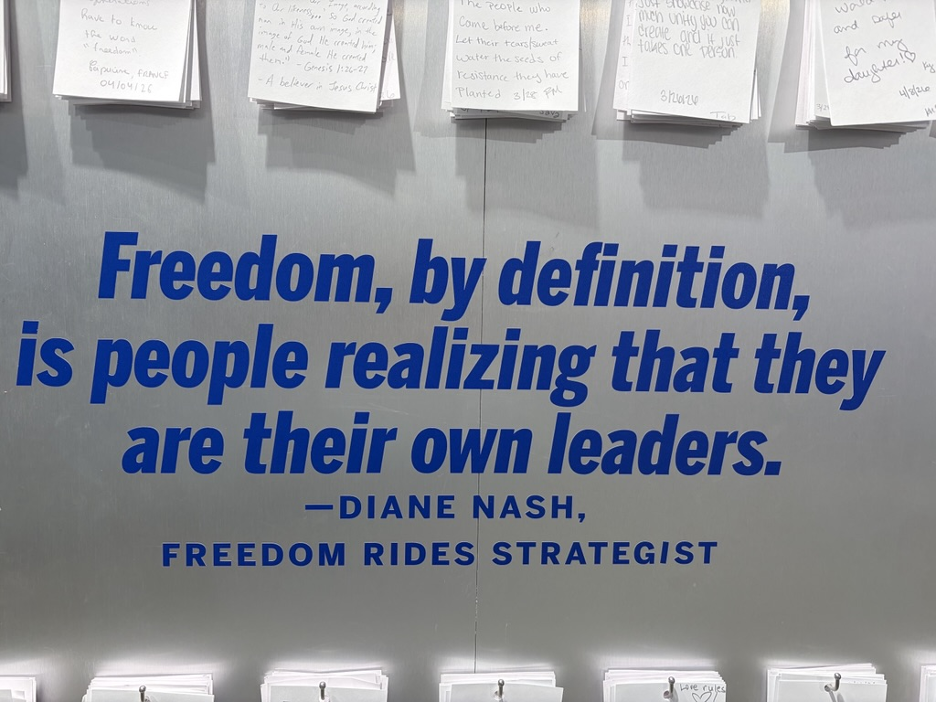
When I came across this quote at the Freedom Rides Museum last month, it immediately jumped out at me. I was in Montgomery, Alabama for the first day of a trip to the Equal Justice Initiative, traveling with a group of fellow leaders from North Carolina. It was there that I dove deeper into the story of Diane Nash. Diane Nash wasn’t just a participant in the Civil Rights Movement; she was a master strategist. She co-founded the Student Nonviolent Coordinating Committee (SNCC), which shifted the movement’s momentum by centering the voices of politically active youth.
Her impact didn’t stop there. Diane was a linchpin in the Freedom Rides, recruiting student Riders who stepped up to challenge racial discrimination across the South when others were hesitant. By organizing what she called a “nonviolent army,” she helped thousands of people find their power. Her relentless work to end the disenfranchisement of Black Americans paved the way for the landmark Civil Rights Act of 1964.
Walking through that museum, the weight of leadership took on a new meaning for me. Since stepping into my role as Chief People, Equity and Impact Officer at Education First, I’ve been reflecting deeply on how we can truly live out our mission and values. I often find myself asking: What can I do, through my own leadership, to make a tangible difference in the lives of those around me? especially as we prepare to honor Juneteenth and reflect on the enduring journey toward true freedom.
During our visit, we used a frame for evaluation provided by Dr. Dudley Flood, a legend and namesake of the Dudley Flood Center for Educational Equity and Opportunity: “What? So What? Now What?”. It’s one of the simplest frameworks of reflection–by moving through three reflective stages, you can think about an experience, its implications and what that means for the future.
Dr. Flood encouraged us to use this lens to determine how we can make a difference in our communities based on what we learned during our visit.
The experience was visceral. As I read the narratives of enslaved people at the Freedom Monument Sculpture Park and took in the names of lynching victims at the National Memorial of Peace and Justice, I was moved to tears. I felt a crushing mix of anger, sadness and anxiety, but also profound gratefulness and pride. I was confronted with the weight of being a living legacy of a horrific moment in American history, while simultaneously rejoicing that I live a life of civil liberties that my ancestors could not have imagined.
My “what” became clear: I must live a life that honors their struggles by pushing for a high-quality education system where income and race no longer determine the quality of a child’s future. The intentional lack of access to opportunity that defined slavery and segregation continues to impact our progress today, which is why I must be all-in on ensuring our education system prepares every child for the life they deserve.

So, what does this mean for our work? At Education First, we know that redesigning a racist and inequitable education system is necessary to create a society where everyone can thrive. We prioritize dismantling racism with an intersectional lens to design systems that no longer disadvantage students and leaders of color.
We have a unique approach that bridges policy, practice, and philanthropy to drive equity-centered change across the education landscape. At Education First, we believe that education initiatives succeed by turning innovation into impact. My participation on this trip was evidence of this commitment. Years ago, I led a North Carolina Racial Equity and Social Impact Community of Practice which focused on collective actions to improve educational funding in North Carolina. As a result, those leaders began aligning their funding efforts to be more impactful collectively than they were individually. This very trip was funded by two of those philanthropic leaders from Burroughs Wellcome Fund and the Conway/Holderness Family Fund who saw this journey as an opportunity to partner and advance the state’s commitment to an equitable education system through the leaders working in service of it.
Since returning from Montgomery, I continue to contemplate: “Now what am I going to do differently?”. Moving forward, I am committed to three key actions:
I invite you to consider your own “What? So What? Now What?”. In these times of shifting landscapes, how will you remain rooted, tenacious, and connected?