
 The middle grades represent a critical window for students. Research demonstrates that early adolescence is a developmental “sweet spot” when children are open to identity experimentation, making it the perfect time to channel their natural curiosity into planning for the future, skill development, and career exploration. It is also a crucial time as research further shows that this is a “critical window for decision making” that informs students’ occupational identity – or the ability for students to see themselves in a wide variety of careers.
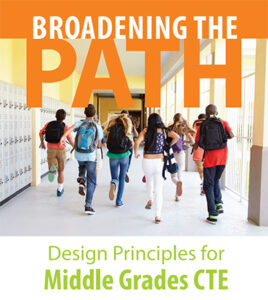
To help state and local leaders make the most of this formative time, Advance CTE and the Association for Career and Technical Education (ACTE) published Broadening the Path: Design Principles for Middle Grades CTE. This resource was developed with input from a range of state, national, and local leaders. Broadening the Path lays out a clear theory of action, defining core student learning outcomes and 10 essential design principles that should undergird any middle grades Career Technical Education (CTE) policy or program. The framework emphasizes that middle school CTE should be an inclusive, standards-based experience anchored in active career exploration, experiential learning, and intentional employer engagement.
In Delaware, we saw this tool’s transformative potential and made it our definitive North Star. In January 2022, the Delaware Department of Education, Rodel Foundation and Education First launched the Rethinking Middle Grades initiative. Our overarching goal was bold but essential: to ensure that youth exit eighth grade ready for high school, having found success in CTE, academic, and social-emotional (SEL) programming that is equity-centered and inspires student identity development and a path to postsecondary success.
Using Broadening the Path as a foundation, Delaware brought together a diverse 29-member Steering Committee, including educators, parents, university students, employers, and community-based organizations, to define our vision. From there, a dedicated Standards Writing Committee developed the state’s Middle Grades CTE Exploration Standards.
Delaware chose to develop holistic, equity-focused standards designed to support every middle school student in their own career exploration and identity development. Then we worked with the students on our advisory committee, and they designed a Profile of a High School Ready Student. The standards are intentionally designed to be cross-curricular, focusing on broad clusters of self-awareness and foundational skills that all students can integrate into existing core classes. The standards guide students through actionable domains, such as increasing self-awareness to understand their aptitudes and interests, developing employability and foundational technical skills, and making informed educational choices for their next steps in high school.
But standards on a page are only the beginning; the real impact happens in the classroom. Supported by a $1 million grant from Rodel, which served as an initial investment for development and piloting, Delaware is piloting these programs across a cohort of middle schools. The framework is designed to be highly adaptable and can be scaled in any district using existing federal CTE funds, such as Perkins V, or by strategically reallocating resources. Through our active Communities of Practice, these pilot schools are sharing ideas and fundamentally transforming the middle school experience by shifting away from sit-and-get instruction to authentic, student-centered learning. The professional development for these communities focused heavily on shifting teacher practice toward career-connected Project-Based Learning (PBL) and ensuring adults know how to push against biases that students are bombarded with about who belongs in certain career paths.
At ASPIRA Academy, for example, the focus is heavily on building transferable, employability skills from the start. Mr. London, an educator at the school, adapts the curriculum so students can see how skills like communication and teamwork apply to their everyday lives, noting, “It’s about helping them understand these skills in the present, while also showing how they’ll transfer to their future careers.” A cornerstone of their approach is building school-wide buy-in, led by Principal José Avilés, who ensures that all teachers understand the “WHY” behind the work and their role in connecting classroom learning to future possibilities.
This approach empowers students to explore without pressure. The results speak for themselves. One ASPIRA team member shared the transformation of a student who previously didn’t speak in class but now asks, “I want to be a veterinarian. How do I get there?” The impact has been encouraging: students are more engaged, more curious, and more aware of the paths ahead. In fact, a major part of this program is ensuring that student voice is at the center of the work. This began with two students sitting on the original advisory committee that designed this work. That led pilot schools to conduct focus groups with students, student panels to speak with educators at our community of practice gatherings, and one school even to have two students serving on its planning team. All the student voices have shaped the work educators are doing.
Our call to action is clear: We urge state, district, and school leaders, and teachers nationwide, to rethink their middle school design. We encourage you to align your programming with the design principles in Broadening the Path and the holistic, student-centered approach found in Delaware’s standards. By intentionally reimagining the middle school experience, we can ensure every student has the tools, social capital, and self-awareness to successfully navigate a future filled with purpose and passion.



 for updates